STATUS QUO №1
Hand-editing locale files
Eleven JSON files that drift apart quietly. A Polish fix pasted in from an email. Nobody knows why de.json has three keys the others don't.
local-first · git-native · MIT
Glotfile is a translation manager that lives in one JSON file, committed next to your code. Edit in a local web UI, translate with your own AI key, export to your framework's locale format. No platform, no account — nothing leaves your machine except the AI calls you choose to make.
npx glotfile
Node 20+ · runs on 127.0.0.1 · delete glotfile.json and it's like it never happened
Minutes, not days.
Batch-translate a whole locale in one command. New strings come back filled in seconds — not a vendor turnaround cycle — so the diff is ready before you've left the branch.
No minimum cost.
No per-seat fee, no monthly floor, no per-word markup. You pay your own AI provider by the token — or point it at Ollama and translate for nothing at all.
STATUS QUO №1
Eleven JSON files that drift apart quietly. A Polish fix pasted in from an email. Nobody knows why de.json has three keys the others don't.
STATUS QUO №2
Your strings live in someone else's database and come back as bot PRs. You pay per seat, per word, per month — for access to your own copy.
Glotfile's take: translations are code. Put them in the repo, review them in PRs, and both problems stop existing.
01
Run it in your project. Glotfile finds your existing ARB, PHP, JSON or .po files, imports every key, and writes one deterministic glotfile.json. No config, no account.
02
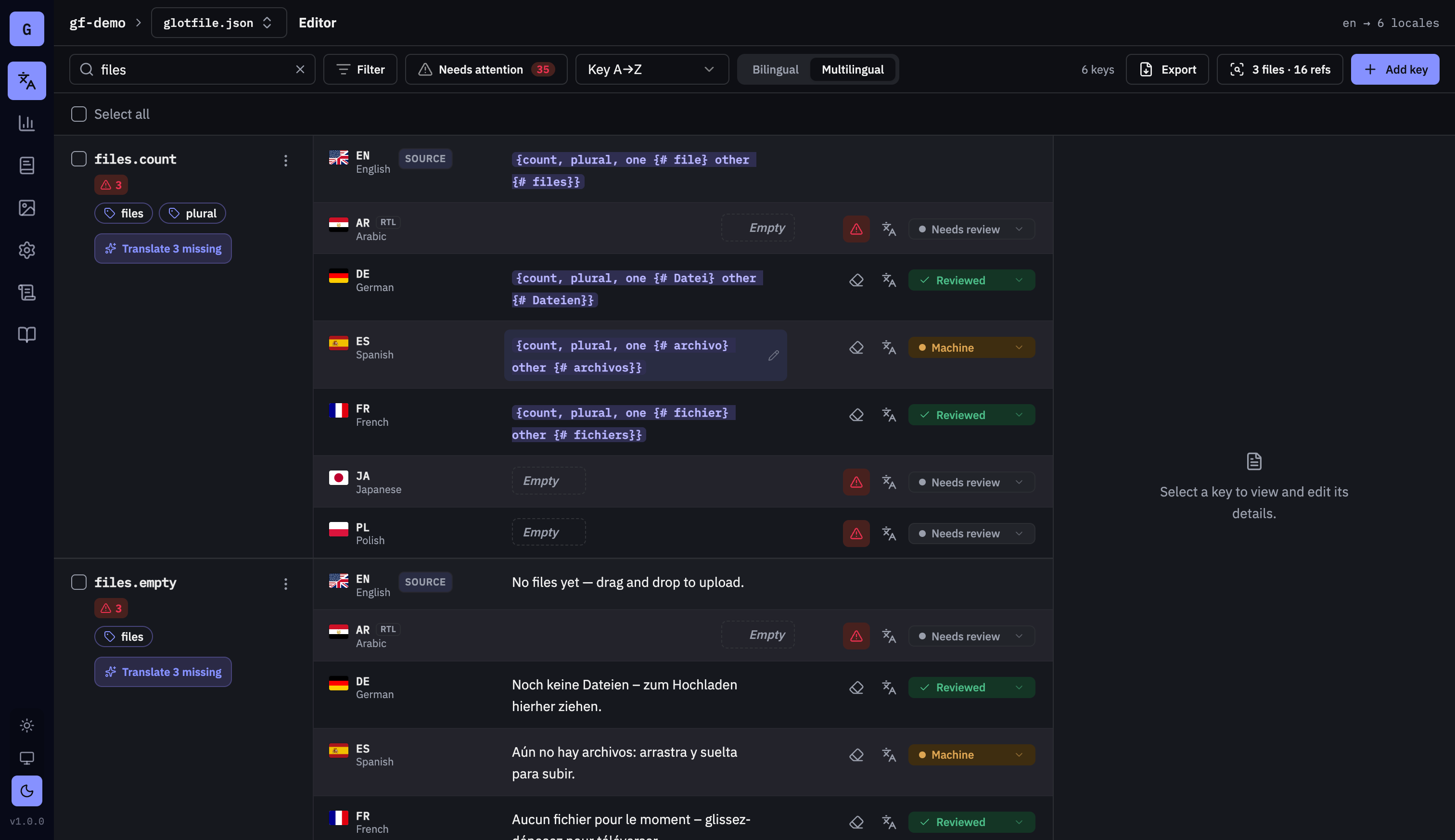
One command starts a web UI on 127.0.0.1 — search, plurals, RTL, review states. Fill missing locales with the AI provider you already pay for. Context comes from how the string is used in your code, not a guess.
03
Write your platform's native locale files and commit everything. Output is deterministic — stable key order, fixed indent — so a translation change is a small reviewable diff, and an unchanged export is a zero-line one. Safe to run in CI.
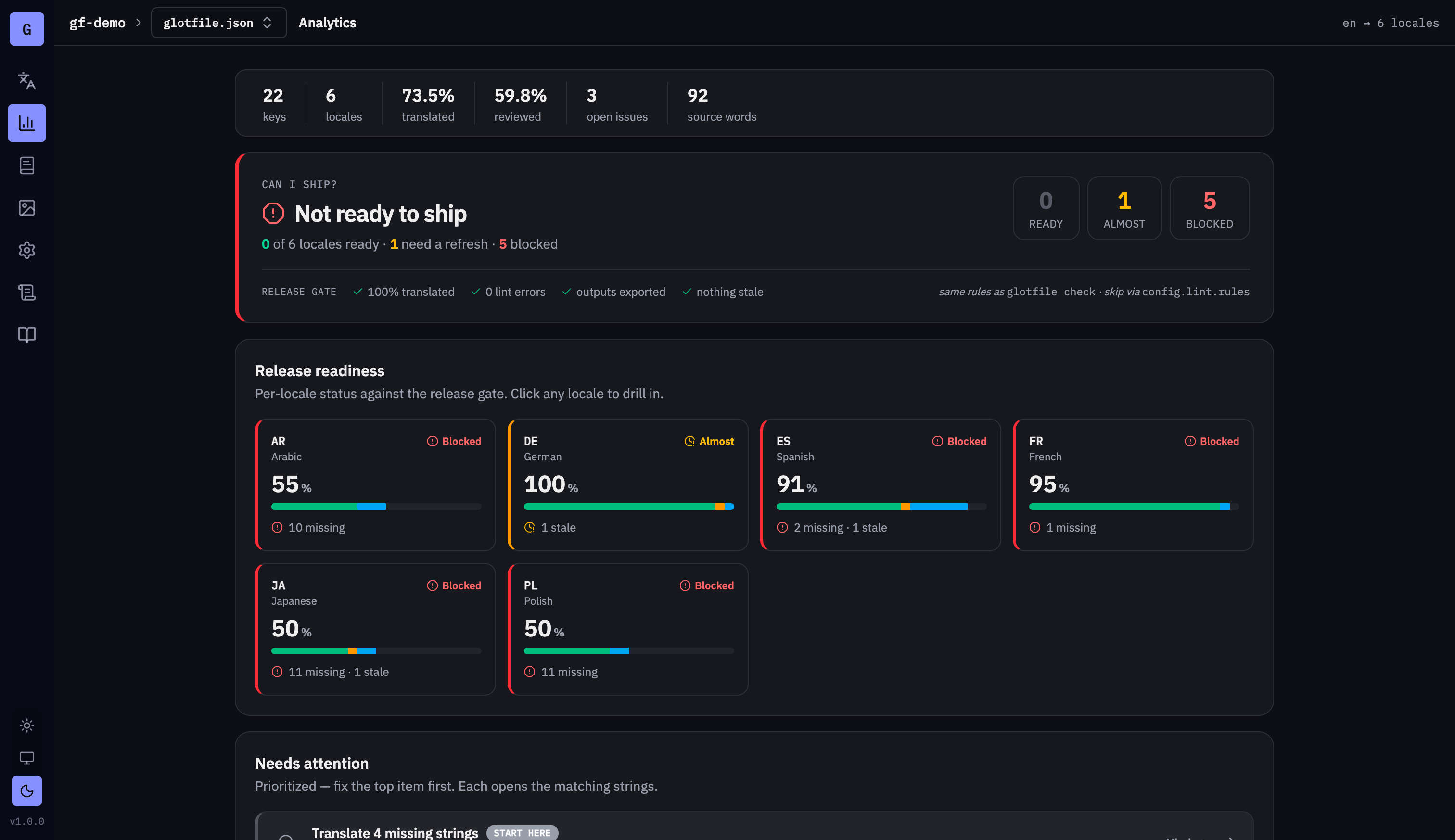
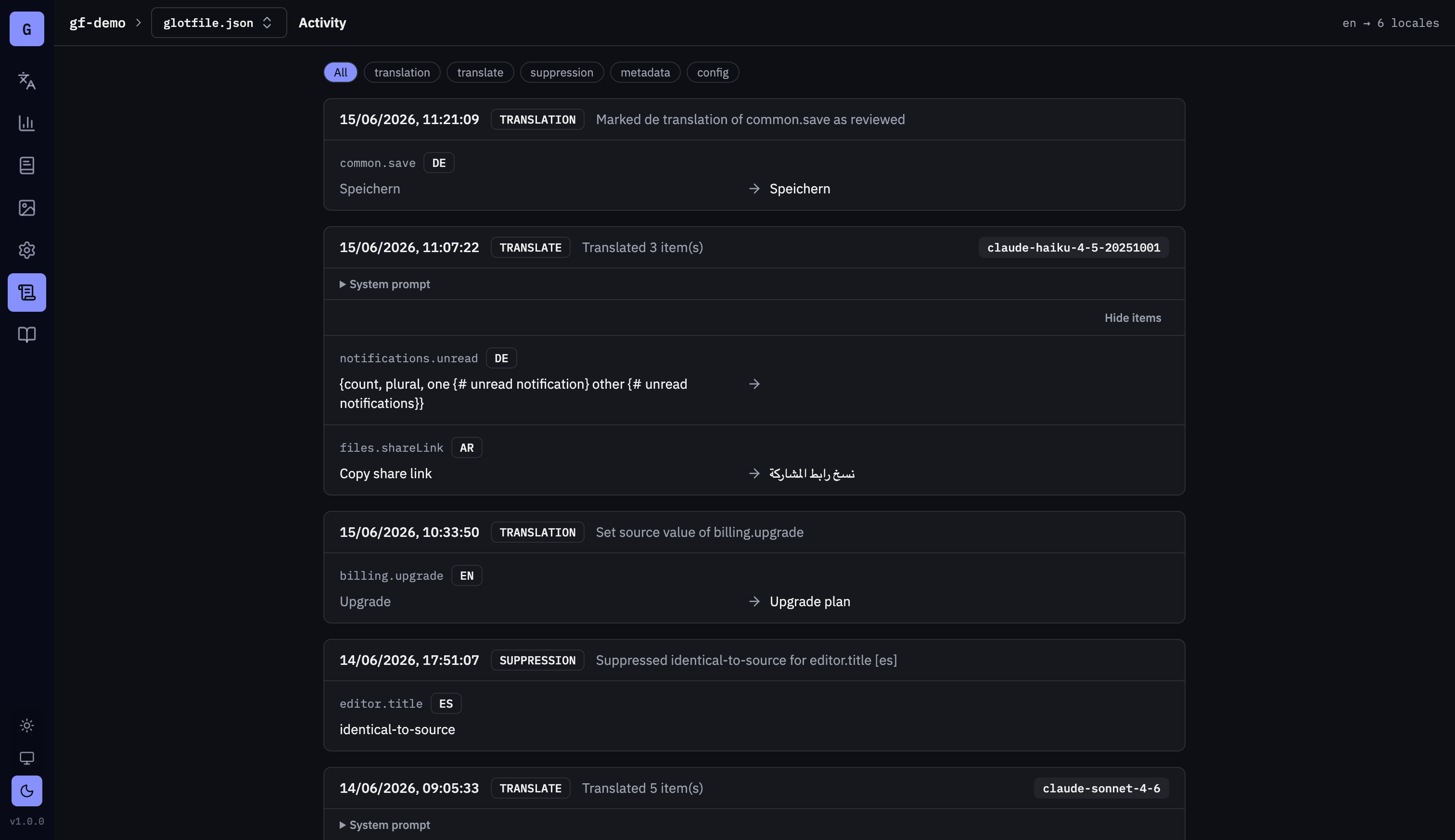
Run npx glotfile and it opens on 127.0.0.1 — dark mode, right-to-left, plurals, a “can I ship?” release gate, and an audit log of every AI call. Every panel reads and writes the one JSON file you commit.
Lingo is an AI assistant built into the UI. It reads your code and your string catalogue, then helps you sharpen the things that make machine translation good — context, glossary, tags, length budgets. Press ⌘/Ctrl + J, say what you want, and it proposes the edits for you to approve. It never quietly rewrites your translations.
Two different senses share the word. plant.feed.cta is used in PlantCareScreen.tsx — that's fertilising a plant. home.feed.title is the activity stream.
Want me to add per-key context and a glossary note so the model stops conflating them?
✓ context added to plant.feed.cta
✓ context added to home.feed.title
✓ glossary: “feed” → noted plant vs. social sense
Reads your codebaseGreps your source and opens files to see how a string is actually used — so its suggestions are grounded, not guessed.
Builds the context, not the translationPer-key context, glossary terms, tags and length budgets — the metadata every translation is conditioned on.
One approval, whole taskAgree once and Lingo carries out a multi-step change in a single pass, then shows you exactly what it touched.
Click through to any keyEvery key Lingo mentions is a link — jump straight to it in the editor.
Suggests, never overridesLingo won't write or review translations behind your back. The wording stays yours.
No server, no sync, no account. One npx command and you're editing. Nothing to host, nothing to cancel.
One deterministic state file, committed with your code. Review translations the way you review everything else: in the PR.
New strings travel on the feature branch that introduced them — merge, rebase, and revert them alongside the code. No drift between branches, no separate platform to keep in sync.
Anthropic, OpenAI, Bedrock, OpenRouter, Claude Code — or Ollama, fully offline. Your key, your model, your bill.
Send a whole locale through Anthropic's Batch API at roughly half the per-token cost. Glotfile tracks the job and applies the results when it lands — kick it off and walk away.
Every key can carry context — a usage note, the code locations that reference it, even a screenshot — and your glossary rides along: brand names stay verbatim, fixed terms stay fixed. All of it is sent on every translation, so an ambiguous “Post” comes back as the right verb or noun.
Give a key a character budget and the model is told the limit, so a translation comes back short enough for the button — German included. The max-length check then flags anything that ever drifts over.
First-class export to Flutter ARB, Laravel PHP, i18next, vue-i18n & next-intl JSON, Angular XLIFF, Rails YAML, gettext .po, and Apple .strings/.stringsdict.
Placeholder and spelling lints, unused-key scanning against your codebase, and a CI check that fails when locales drift.
Stable key order, fixed indent, one trailing newline. Re-export with no changes and git sees nothing at all.
EXPORTS TO
TRANSLATES WITH
The server binds to 127.0.0.1 and nowhere else. Your strings travel exactly two places: your git remote, and the AI provider you configure — point it at Ollama and it's just git.
No telemetry, no account, no copy of your strings on anyone else's disk. Your git history is the audit log.